
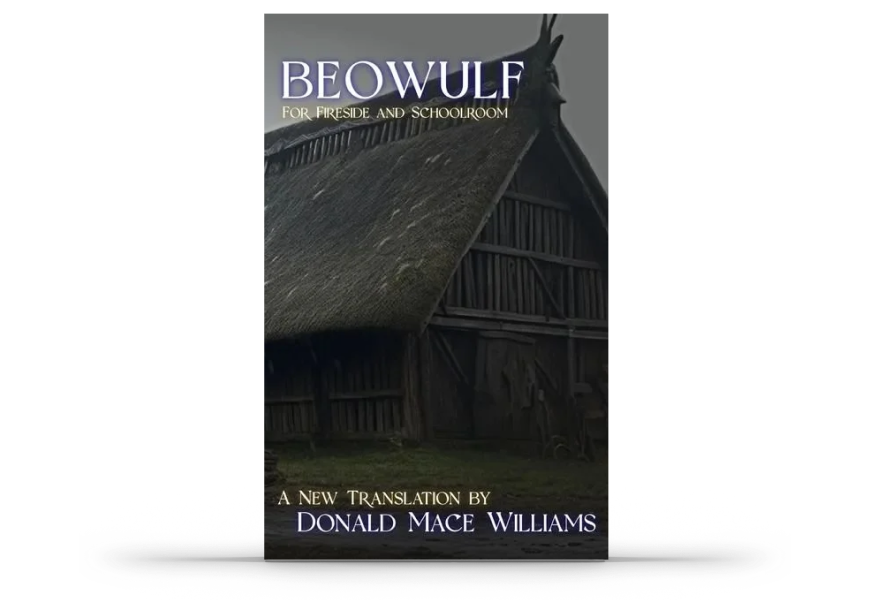

Beowulf: For Fireside and Schoolroom

This new translation of the oldest narrative poem in English—the first in more than twenty years—is designed for easy, pleasant reading. It cuts the scholarly touches to a minimum, using simple margin notes to explain some word or phrase. With students, young readers, and Beowulf fans in mind, Donald Mace Williams has approached his translation as both a published writer of modern metrical poems and a scholar in the verse structure of Beowulf.

About

This new translation of the oldest narrative poem in English has three qualities that set it apart from the many previous translations.

First, it has cut the scholarly touches to a minimum, using only eight end notes to clarify certain passages. Notes in the margin often amount to a single word to explain some word or phrase. The introduction, too, is designed for easy, pleasant reading.

The second quality that makes this translation distinctive is that it is written in iambic meter, familiar to readers of more than six centuries of poetry in modern English. The translation uses almost always four stresses per line, the same as in the Anglo-Saxon, though the alliterative formula of the ancient text is not a part of Williams’s scheme.

The third distinctive feature of the translation is that it keeps the kennings that are such an important characteristic of the original. When the Beowulf poet (or poets) calls the sea the “whale paths,” Williams does the same. To translate the phrase as the “sea,” to Williams’s mind, would take away much of the Anglo-Saxon charm and would deprive the reader of an image.

Donald Mace Williams has approached his translation as both a published writer of modern metrical poems and a scholar in the verse structure of Beowulf. His Ph.D. in that subject was done at the University of Texas under the direction of the noted prosodist and philologist Thomas M. Cable.

Details

Category: Poetry

Publication Date: April 23, 2024

ISBN (paper): 979-8-9879002-7-7

ISBN (ebook): 979-8-9879002-8-4

Pages: 108

Trim size: 5.5 x 8.5

Reviews
The Dewdrop

“Breathtaking”

Sheryl Oliver, Panhandle High School, Panhandle, Texas

“In his newly released translation of Beowulf, Donald Mace Williams has brought the historical context and the sheer drama of the original English poem to life for the 21st century. His fresh take on the story as well as the introductory material make this work far more accessible to students who typically find themselves separated from the novelty and allure that Beowulf should automatically offer to readers. Williams has set the table, so to speak, for today's readers, and as a high school English teacher I look forward to implementing this new version into my curriculum. Many thanks from a grateful teacher!”

Robert Bjork, director of the Arizona Center for Medieval and Renaissance Studies

“From the first word of the brief and extremely helpful introduction to the last word of the translation, Williams captures you and will not let you go. His lyrical prose energizes and delights you; the strategically sparse notes propel you further along; and the whole experience of this powerful book leaves you wanting more. I strongly recommend it.”

About the Author

Donald Mace Williams

Donald Mace Williams is a former writing coach for The Wichita Eagle and reporter and editor for papers that include Newsday, the Fort Worth Star-Telegram and the Amarillo Globe-News. He has taught English and journalism at West Texas State and Baylor Universities. Williams holds a doctorate in English from the University of Texas. He lives in Canyon, Texas, and his poetry has been published widely in journals in the U.S.

Reviews

The Dewdrop

“Breathtaking”

Sheryl Oliver, Panhandle High School, Panhandle, Texas

“In his newly released translation of Beowulf, Donald Mace Williams has brought the historical context and the sheer drama of the original English poem to life for the 21st century. His fresh take on the story as well as the introductory material make this work far more accessible to students who typically find themselves separated from the novelty and allure that Beowulf should automatically offer to readers. Williams has set the table, so to speak, for today's readers, and as a high school English teacher I look forward to implementing this new version into my curriculum. Many thanks from a grateful teacher!”

Robert Bjork, director of the Arizona Center for Medieval and Renaissance Studies

“From the first word of the brief and extremely helpful introduction to the last word of the translation, Williams captures you and will not let you go. His lyrical prose energizes and delights you; the strategically sparse notes propel you further along; and the whole experience of this powerful book leaves you wanting more. I strongly recommend it.”